.svg)
Merge Fields let you automatically add the right details to your messages, like a lead’s name or an agent’s contact info. This keeps your communication personal, consistent, and easy to scale across your team. Once set up, the system fills in the details for you.
Need to Know
-
Merge fields are placeholders that pull in information automatically, making messaging leads faster and more personalized.
-
They work in Email templates, SMS-Text templates, and Live Chat templates.
-
With merge fields in your templates, the right details fill in automatically based on who you’re messaging.
-
This saves you from retyping, keeps each message personalized, and reduces errors so emails, texts, and chats still feel tailored, even in automated workflows or shared team templates.
-
-
The assigned agent stays front and center in every message, with their name and contact details pulled in automatically (even in automated workflows) so follow-up feels personal while agents focus on calls and appointments, making this a strong recruiting selling point.
Table of Contents
How to Use Merge Fields
Merge fields can be added to any email, text, or chat template so messages fill in details automatically when sent.
Step-by-Step Instructions:
-
Open your message template
-
Place your cursor where you want information to appear
-
Select a merge field from the merge field list
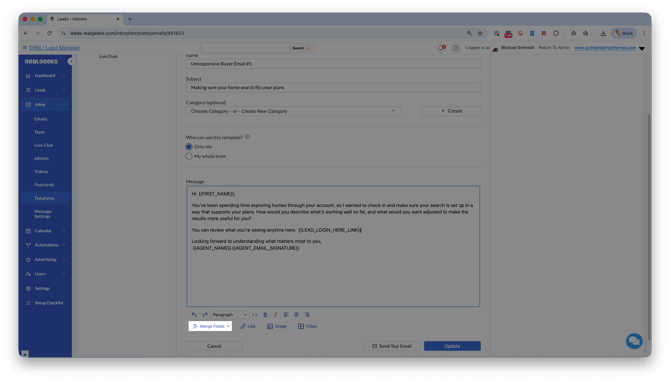
-
Save the template
Understanding Lead-Based Merge Fields
Lead-based merge fields pull in information that belongs to the lead. These are most often used to personalize messages and help leads easily access your website.
Lead-based fields can automatically:
-
Address the lead by name
-
Display their contact information
-
Log them into your website without a password
-
Send them directly to useful tools like advanced search or market reports
Common Lead Merge Fields:
-
Lead full name:
{{NAME}} -
Lead first name:
{{FIRST_NAME}} -
Lead last name:
{{LAST_NAME}} -
Lead email address:
{{EMAIL}} -
Lead phone number:
{{PHONE}} -
Lead login link:
{{LOGIN_LINK}} -
Advanced search link:
{{LEAD_ADVANCED_SEARCH_LINK}} -
Market report link:
{{LEAD_MARKET_REPORT_LINK}}
These links automatically log the lead into their account and open the right page, removing friction and making it easier for them to take the next step.
Understanding Agent-Based Merge Fields
Agent-based merge fields pull in information for the agent assigned to the lead. This ensures every message shows the correct agent details without manual updates.
Agent-based merge fields help you:
-
Keep messages consistent across a team
-
Create one single message that can be used by all of your other agents
-
Automatically show the assigned agent’s contact details
Common Agent Merge Fields:
-
Agent full name:
{{AGENT_NAME}} -
Agent first name:
{{AGENT_FIRST_NAME}} -
Agent last name:
{{AGENT_LAST_NAME}} -
Agent email address:
{{AGENT_EMAIL}} -
Agent phone number:
{{AGENT_PHONE}} -
Agent email signature:
{{AGENT_EMAIL_SIGNATURE}}
Best Practices
-
Use merge fields in templates you send often
-
Include login (
{{LOGIN_LINK}}) or search links ({{LEAD_ADVANCED_SEARCH_LINK}}) to guide leads back to your website - Agent merge fields will default to display the Site Owner's contact information if the lead is unassigned
Troubleshooting
-
If a merge field doesn't appear correctly, confirm the merge field is formatted correctly in your message template. Use the Merge Field menu to select the data you want to display
-
Always send a test message to yourself when building new templates to ensure the information appears correctly
Frequently Asked Questions
Do merge fields work in workflows?
Yes. Merge fields work in workflows, emails, texts, and live chats.
Can I edit the information pulled in by a merge field?
The field pulls from the lead or agent profile. Update the profile to change what appears.
Need Help?
- Call us at 844-311-4969 (Mon–Fri, 8 AM–8 PM CST)
- Email support@realgeeks.com
- Visit Real Geeks University for free video courses
- Join the Real Geeks Mastermind Group on Facebook for peer tips and best practices