.svg)
Admin Feature
Editing the website is an account owner-level permission. If you don't see this option, contact your account owner to enable these permissions for you.
Content Pages are flexible pages you can use to add almost any type of information to your Real Geeks website. Create buyer and seller resources, neighborhood guides, local recommendations, business information, and other content that helps turn your website into a useful resource for potential clients.
Need to Know
-
Content Pages can be used for almost any type of custom website content.
-
Add text, images, links, videos, property listings, and other resources to keep visitors engaged.
-
You can select different page templates to add specific functionality to a Content Page.
-
Creating useful, specific content gives search engines more information about your business and the markets you serve.
-
Think beyond creating a page. Share your Content Pages in emails, texts, and social media to bring leads back to your website.
Table of Contents
About Content Pages
A Content Page gives you a flexible space to publish information on your Real Geeks website.
Use Content Pages to create resources that answer the questions buyers and sellers are already asking.
For example, you could create:
-
Answers to common questions from leads
-
Information about your business or services
-
Neighborhood and community guides
-
Buyer and seller resources
-
Moving and relocation information
-
Local business and attraction guides
-
Financing or home-buying information
-
Market information
-
Frequently asked questions
The goal isn't just to add more pages to your website. Create information that's genuinely useful to the people you want to work with.
A helpful page can give potential clients another way to
-
Find you through search engines
-
Demonstrate your local knowledge
-
Give existing leads a reason to return to your website.
You can also share these pages directly with leads. Instead of explaining the same topic repeatedly, send them a helpful resource from your own website.
Create a Content Page
-
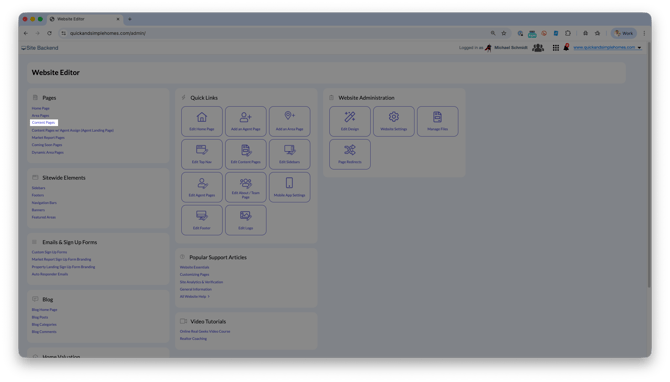
Add /admin to the end of your website domain (example: www.yourdomain.com/admin)
-
Click Content Pages
-
Select Add Content Page
-
Enter the appropriate page details, content and customizable settings
-
Click Save or Save and Continue Editing to apply your changes and create the page.
Set Up Your Page
Start by adding the basic details that define your Content Page and help organize it on your website. These details control how the page appears to visitors, how it’s labeled in your website editor, and how search engines understand what the page is about.
-
Parent – Organizes this page under another page and makes it part of that page's URL structure.This setting is optional and not recommended for most users, so leave it blank unless you specifically want to group related pages together.
-
Title – Enter a clear title that tells visitors and search engines what the page is about. Include the relevant location or topic when it makes sense.
-
Meta Description – Write a short summary of what visitors will find on the page. This helps search engines understand your content and may appear with your page in search results.
-
Meta Keywords – Add keywords related to the page's topic or location, separated by commas. Focus on terms potential clients might use when searching for this information.
-
Anchor Text/Page Name – Add a simple internal name that helps you identify and find the page in Real Geeks. Visitors generally won't see this.
-
Slug – Customize the final part of the page's URL. Keep it short, descriptive, and easy to understand, such as
/richardson-tx/.
Add Your Page Content
Use Page Content to choose the page's functionality and add the information visitors will see.
Template Selection
Select a template based on the purpose and functionality you want for your Content Page.
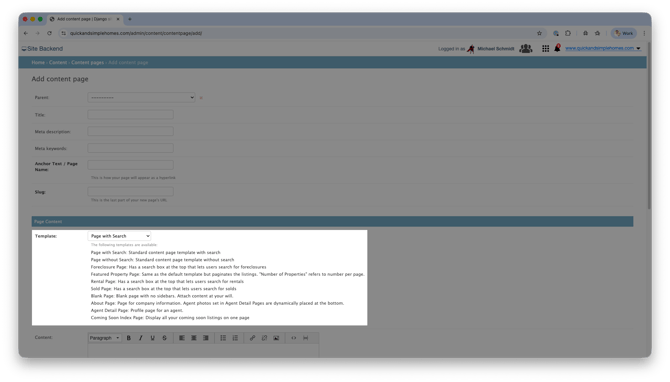 Some templates add special features or change how information is displayed on the page.
Available Templates
Choose a template based on the type of content you want to create and how visitors should interact with the page.
-
Page with Search: Best for SEO-focused content where visitors can read helpful information and immediately begin searching for properties.
-
Page without Search: Best for educational pages, guides, landing pages, or blog-style content where you want visitors to focus on the written material.
-
Foreclosure Page: Use to target foreclosure-related searches and allow visitors to explore foreclosure listings directly from the page.
-
Featured Property Page: Use to showcase a curated group of listings, such as luxury homes, waterfront properties, or office picks. Use Number of Properties to control how many listings appear on each page.
-
Rental Page: Use to reach renters or investors searching for rental properties.
-
The Rental Page template only appears when rental property data is enabled on your website. Contact support@realgeeks.com to have it turned on.
-
-
Sold Page: Use to showcase sold properties, demonstrate market activity, build credibility, and attract potential sellers.
-
Blank Page: Best for advanced layouts, custom landing pages, embedded tools, or unique designs without sidebars or a preset structure.
-
About Page: Designed for your company story, mission, and team overview. Agent photos added to Agent Detail Pages automatically appear at the bottom.
-
Agent Detail Page: Use to create an individual agent profile that highlights their bio, experience, and contact information.
-
Coming Soon Index Page: Use to display all Coming Soon listings in one place and build early interest in upcoming properties.
Content Editor
Use the Content Editor to build the main content visitors will read, view, and interact with on your page. This is where you turn your expertise into something genuinely useful by adding clear information, helpful resources, and strong calls to action that keep visitors engaged.
Add information such as:
- Text
- Images
- Videos
- Links
- Headings
- Lists
- Calls to action
Customize Your Page
Use the available page settings to customize how your Content Page looks and how visitors can interact with its content.
Override Landscape Image or Video
 Personalize the image or video that appears at the top of the page. Choose something that matches the page's topic or local area to make the page more relevant and engaging to visitors.
Why use it: A strong local image or video can grab a visitor's attention and immediately show them that they've found information specific to what they're looking for.
Sidebar/Footer/Banner Options
 Use these options to add helpful information and resources in different areas of your website.
- Sidebar: Give visitors quick access to related pages, resources, or other information they may want to explore.
- Footer: Add important information that visitors can access from the bottom of your website.
- Banner: Highlight an important announcement, resource, or call to action you want visitors to notice.
Why use them: Don't let a useful page become a dead end. These areas can point visitors toward more of your content, encourage them to explore your website, and give them more opportunities to connect with you.
Learn More:
Capture Form Display Options
Turn this page into a landing page that requires visitors to register before they can access the page content.
 Choose how and when the capture form appears, then customize the registration experience to encourage visitors to provide their contact information.
Why use it: Requiring registration can help you convert page visitors into leads by collecting their contact information before they view the page. Use this option when the content offers enough value that visitors are likely to register for access.
Learn More:
Property Display Options
Customize how property listings are displayed on your Content Page.

Why use it: Make listings easier for visitors to browse and focus their attention on the property information that's most useful to them.
Learn More:
Search Form Display Options
Customize the property search and headline visitors see on the page. A search gives visitors an easy next step when they're ready to start exploring homes.
 Why use it: Make it easy for visitors to go from learning about an area or topic to actually searching for homes. The more useful your website is, the more opportunities you have to keep visitors engaged and turn that traffic into leads.
Please Note
The available search options depend on your website design. Miranda, Miranda-Thin, and Molly support additional search customization. Anna and Anna Modern use the type-ahead search.
Learn More:
Put Your Content Page to Work
Once you've created a useful page, don't wait for people to find it on their own.
Share it with potential and existing clients to bring them back to your website.
For example:
-
Send a neighborhood guide to a lead interested in that area.
-
Share a buyer resource when someone asks a common question.
-
Include useful pages in your automated communication campaigns (workflows).
-
Share local resources through email or social media.
-
Link related Content Pages together so visitors can continue exploring your website.
Best Practice: Think of every useful Content Page as a resource you can reuse. Create it once, then use it in your follow-up and marketing whenever that topic comes up.
Frequently Asked Questions
-
What is the difference between a Content Page and an Area Page?
Content Pages are flexible pages for general topics like guides and resources. Area Pages focus specifically on neighborhoods or cities. -
Can I edit a Content Page after publishing it?
Yes. You can return to the Content Pages section in your admin panel at any time to update text, images, or settings. -
Do Content Pages help with SEO?
Yes. When optimized with strong keywords and helpful information, they improve search visibility and attract organic traffic. -
Can I add a property search widget to a Content Page?
Yes. You can embed search widgets or other tools inside the content editor to make the page interactive.
Need Help?
- Call us at 844-311-4969 (Mon–Fri, 8 AM–8 PM CST)
- Email support@realgeeks.com
- View our Live Events page for free coaching and training.
- Join the Real Geeks Mastermind Group on Facebook for peer tips and best practices